
What We’ve Learned About Planning Newborn Care Around Due Dates

As an organization that plans care for babies and their families in the first days after birth, it’s important to understand what due dates can tell us and what they can’t.
We’ve worked with thousands of babies providing in-home newborn care, and we’ve noticed some trends.
The latest data about gestational age supports what we know from experience – your baby probably won’t arrive on their due date, it matters where you live, and it matters even more when your last baby was born.
Your Due Date vs Your Due Month
One of the first things that happens when pregnancy is confirmed is to calculate the due date. This is often based on the date of the last menstrual period (LMP) plus 280 days. An ultrasound measuring the size of the fetus in the first trimester has been found to be the most accurate way of estimating or confirming a 40-week due date. However, only about 5% of babies are actually born on their exact due date.
There is a reason that our Newborn Care Specialists have an on-call period that starts two weeks before the client’s due date – the most common week for births to occur in the United States is 39 weeks, and this includes both spontaneous vaginal births, inductions, and cesarean deliveries. A normal “term” birth is considered any time between 37 weeks and 42 weeks, and about 91% of babies are born during the window. So a due date can really be thought of as a due month with a range of 5 weeks!
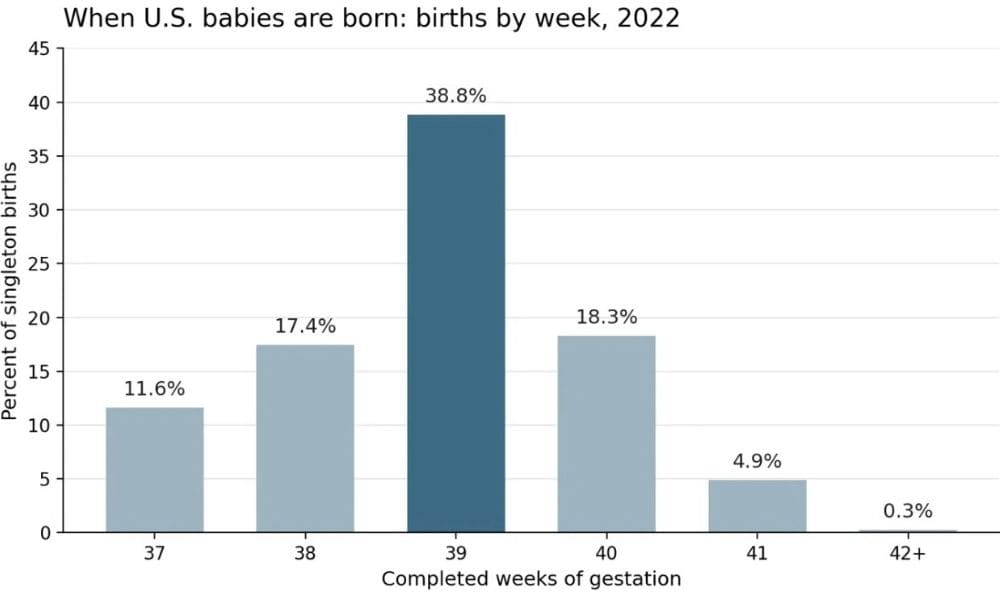
When planning care around your due date, it’s important for you and your overnight care team to be flexible around start dates [and not to panic if baby doesn’t arrive right “on time”]. Twins or triplets are also likely to be born earlier than singletons, so it will help to have your care in place with time to spare.
Regional Differences
Well Supported Family sees births from all over the country, and again, the data supports the patterns that we see. Different regions see slightly different rates of births at different times.
For example, while only 12% of births in New York City occur after 41 weeks, a larger percentage of births in Vermont (about 18%) occur that late. Babies in Louisiana, Mississippi, and Alabama are born the earliest, while babies in Vermont, New Hampshire, and Oregon are born the latest.
Even within the same state, urban vs rural counties can see a difference when births will occur, but it depends on which state you live in. In New York, Massachusetts, and California, babies in metropolitan areas are born slightly earlier than in rural counties. But in Alaska, Georgia, and Kentucky, rural areas see births earlier.
There may be many reasons for these differences – the prevalence of midwives vs OBs, overall rates of induction and planned cesarean births, or the number of high-risk pregnancies in specific areas. There is also a big difference between a state’s overall average and your personal circumstances, so none of these trends is a guarantee of whether your baby will arrive sooner rather than later.
Timing of Previous Births
A major predictor of whether your baby will arrive early term (from 37 weeks to 38 6/7 weeks), full term (from 39 weeks to 40 6/7 weeks), or late term (from 41 weeks to 41 6/7 weeks) is the timing of previous pregnancies. A 2013 study found that if participants had previously given birth on the later end of the range, they were likely to deliver late again.
The study also found that older parents tended to deliver later than young parents, and that the parent’s own weight at birth was associated with their delivery date – the heavier mom was when she herself was born, the later she was likely to deliver. [Weird!]
What to consider when planning for care
When a family starts planning for their overnight newborn care, it’s important to consider several factors in addition to their due date. Here are some of the questions we ask to help families plan for the right support at the right time.
- Is this your first pregnancy? Studies show that first-time parents deliver slightly later (and their labors are longer) than parents who have had babies before.
- When did your previous pregnancies deliver? Studies show that the timing of previous births is highly correlated with the timing of future deliveries.
- Are there are any circumstances that might lead to an early delivery? This could include medical complications like gestational diabetes or high blood pressure, but it could also include your care provider’s comfort in going past full term.
- Will you want care to begin right away? While many parents want care on the first night home from the hospital, some families will have grandparents or extended family in town who want to help. Consider all members of your support team, in addition to a Newborn Care Specialist.
While there is no way to know for sure the exact day your baby will arrive, thinking about your due date as a range may help you plan with appropriate flexibility for newborn life, where babies can change profoundly from week to the next.
Learn more about how we will plan around your “due month” by setting up a call with Well Supported Family today.

Helpful tips from your team at Well Supported Family.
Expert postpartum and newborn advice you can trust.
Since 2016, Well Supported Family has walked alongside thousands of new parents as they adjust to life with a newborn. Our certified Postpartum Doulas and Newborn Care Specialists offer daytime, overnight, and 24/7 in-home care across the United States, bringing steady, knowledgeable support right to your door. If you’re recovering from birth, navigating feeding, or simply overwhelmed by the lack of sleep, we’re here to make those early days feel a little lighter.
Want to explore in-home care for your new family? Reach out today.