

The early parenting transition is the period from the last weeks of pregnancy through the first 90 days home with a newborn. It can be physically exhausting, emotionally intense, socially isolating, and far more demanding than most parents expect.
At Well Supported Family, we work within this phase every single day, inside real homes, with real families, during the hardest hours of overnight newborn care.
- We are there at 6 am when the feeding isn’t going well.
- At 6 pm, when parents are exhausted and wondering how they’ll get through the night.
- At 4 am, when the baby won’t stop crying.
This phase is not just about sleep. It is about adjustment. Identity. Recovery. And learning how to live inside a completely new rhythm.
What Feels Hard Is Often Predictable
The early weeks with a newborn can feel chaotic, even when everything is technically “going well.”
Feeding can feel relentless and unpredictable. Babies cluster feed. They fall asleep mid-feed. They wake again 45 minutes later. Parents wonder if something is wrong when this intensity is simply newborn physiology.
Sleep becomes fragmented in ways most adults have never experienced. It is not just less sleep. It is broken sleep. And broken sleep alters mood, patience, perspective, and partnership.
If you’re a birthing parent, postpartum recovery is layered on top of that exhaustion. Bodies are healing. Hormones are fluctuating. Pain may still be present. And yet the expectation to function remains.
Emotions can feel sharper. Tears come quickly. Small decisions feel heavier than they should.
Partnership dynamics shift. One parent may be physically recovering while the other feels unsure how to help. One may be breastfeeding while the other handles burping, diapering, or late-night pacing. Both can feel exhausted, stretched thin, and unseen in different ways.
Daily structure dissolves. There can be no clear beginning or end to the day. Meals happen inconsistently. Showers feel optional. Social contact narrows.
None of this means you are doing something wrong.
It simply means you are in the early parenting transition. We have worked in thousands of homes: in shoebox apartments and sprawling estates, with parents navigating this largely alone and parents surrounded by support. First-time parents. Third-time parents. Sixth-time parents. The circumstances vary, but the adjustment is universal. Behind closed doors, every family is recalibrating in ways that aren’t visible from the outside.
The gap between what newborns need and what parents need
Babies in the first 90 days need frequent feeding, physical contact, and irregular sleep. Their nervous systems are immature. Their rhythms are unpredictable. Some settle easily. Others cluster feed for hours or cry in long afternoon stretches or throughout the night.
None of that is unusual.
At the same time, parents also have needs.
- They need consolidated sleep to recover physically and emotionally.
- They need reassurance when feeding and care feels relentless.
- They need space to regulate their own nervous systems when the crying feels overwhelming.
- They need time to eat, shower, and think clearly.
This is where the strain can begin.
- When a baby feeds every hour, a parent becomes depleted.
- When a baby will only sleep in arms, a parent becomes overstimulated.
- When crying stretches longer than expected, anxiety rises.
- When sleep fragments night after night, emotional resilience drops and the baby blues or postpartum depression can be exacerbated.
Nothing is “wrong.”
….But the system becomes unsustainable.
Professional newborn care exists to stabilize that system. We do not override what babies need. We interpret it.
- We assess feeding patterns and bring in structure and scheduling when developmentally appropriate.
- We evaluate sleep patterns and shape habits that allow babies to rest independently in their sleep space.
- We identify root causes of persistent crying or discomfort.
- We protect parental sleep while babies are cared for safely and attentively.
Baby needs are met. Parent needs are protected. The household stabilizes.
Parents may wake from an overnight shift more rested, and to a baby who feels calmer, more settled, and easier to understand.
And when parents are rested, guided, and supported, everything feels more manageable — even when the baby is still a baby.
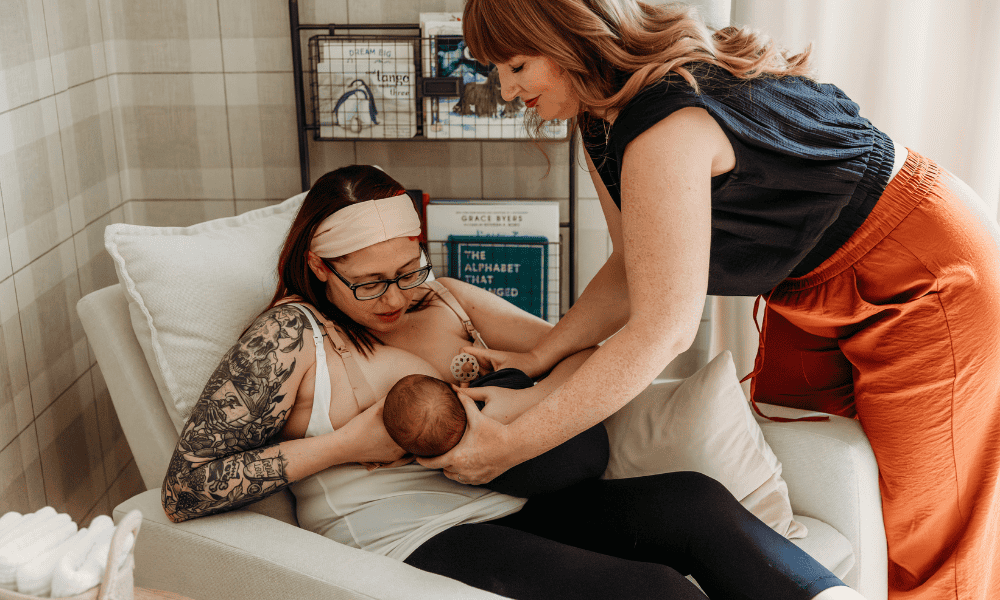
How Professional Newborn Care Works
They say it takes a village to raise a child. In today’s world, that village rarely appears on its own. It has to be built, intentionally.
From day one, we can be by your side.
Professional newborn care is not about replacing parents. It is about extending the family’s capacity during a season that demands more than most households can sustainably give.
As your modern village, we support families in their homes through overnight, 24/7 and daytime care. That includes attentive newborn care, feeding guidance, protection of parental sleep, support for the postpartum period, and steady reassurance during moments that can feel bigger than they should.
- Overnight care protects rest and stabilizes the household rhythm.
- Daytime support creates space for recovery, regulation, and hands-on guidance.
- 24/7 support combines the two and ensures that someone is guaranteed to be there and won’t call out for weather, transportation, or other day-to-day occurrences.
Whether the need is stabilization or full-spectrum support, we meet families where they are. From straightforward adjustments to complex transitions involving NICU care, multiples, medical needs, surrogacy, adoption, foster care, or postpartum mental health, we show up with care to match the reality of the situation.
No matter how your parenting journey begins, we step into the home with one goal: to reduce stress, protect stability, and help you move through the early parenting transition with confidence.
This is not about making the newborn phase easy. It is about making it supported. And when families are supported, everything changes.

Who is This Support Helpful For?
No two families are the same, and neither is the newborn care we provide.
Whether you are recovering from birth, navigating parenthood as a single parent, welcoming a baby suddenly, or balancing older children while adjusting to a newborn, this phase asks a lot of you.
- Whether you have abundant help or very little.
- Whether this is your first baby or your fifth.
- Whether everything feels relatively smooth or unexpectedly overwhelming.
Professional newborn support is not reserved for one “type” of family. It is helpful for anyone moving through the early parenting transition who wants steadiness, rest, and experienced guidance inside their home.
We meet families where they are — and support them from day one.
A Supported Start Changes Everything
The first 90 days are not a test of how much you can handle alone. Bringing in support during the early parenting transition is about protecting your rest, your recovery, and your family’s stability so you can experience these early weeks with more presence and less depletion.
Is it normal for the first 90 days to feel this hard?
Yes. The early parenting transition is physically and emotionally demanding, even when everything is “going well.” Sleep fragmentation, feeding intensity, and postpartum recovery create real strain in most households during this phase.
When do newborn sleep and routines start to feel predictable?
Newborn sleep is biologically irregular in the first weeks. With developmentally appropriate guidance and consistency, many babies begin to show more predictable feeding and sleep rhythms between 6–12 weeks, though every baby is different.
Do all families need professional newborn care during the first 90 days?
Not every family requires hired in-home support, especially those with strong, nearby family help. However, families recovering from birth, living far from support systems, caring for multiples, transitioning from the NICU, balancing older children, trying to get back to work after a short maternity or paternity leave, are managing heightened anxiety, don’t function well on little sleep or simply want a baby that learns healthy sleep habits from an early age- often benefit significantly from additional hands-on care.
How does newborn care support different from online resources?
Online information can educate, but it cannot observe your baby in real time. Professional newborn care provides in-home, hands-on support, assessing feeding patterns, sleep behaviors, and family dynamics directly and adjusting guidance based on what is actually happening in your home. We also offer a video series called Baby Care Classes that complements, but can’t replace in-home care.
Is hiring newborn care a luxury or a necessity?
For some families, it is an added layer of comfort. For others, it becomes a practical and stabilizing necessity. The value lies in sustainability and protecting parental well-being.
When is the best time to book newborn care for the first 90 days?
Most families reserve care during the second to secure availability. Booking before delivery allows time to align schedules and prepare thoughtfully for the early weeks at home. However, even if your baby is here, it’s never too late to ask for help!
Schedule a complimentary consultation to discuss your concerns and determine what level of support would make the early parenting transition more sustainable for your household.

Helpful tips from your team at Well Supported Family.
Expert postpartum and newborn advice you can trust.
Since 2016, Well Supported Family has walked alongside thousands of new parents as they adjust to life with a newborn. Our certified Postpartum Doulas and Newborn Care Specialists offer daytime, overnight, and 24/7 in-home care across the United States, bringing steady, knowledgeable support right to your door. If you’re recovering from birth, navigating feeding, or simply overwhelmed by the lack of sleep, we’re here to make those early days feel a little lighter.
Want to explore in-home care for your new family? Reach out today.