
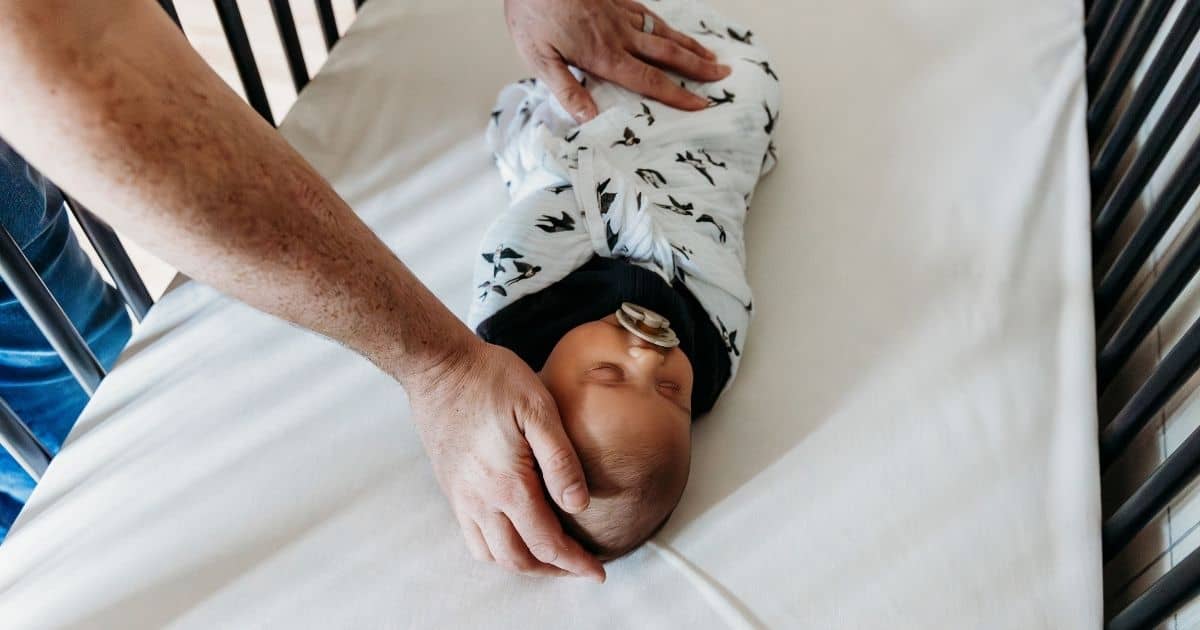
After supporting thousands of families in their homes over the years, we know firsthand that overnight support means more sleep for parents. Parents tell us they feel more rested and are able to function better when they have had support overnight. But does the data back this up? While there are no randomized controlled trials testing professional overnight newborn care directly, there is significant research on the impact of sleep and sleep deprivation on postpartum families.
As an agency that works primarily with parents and their newborns, we understand that newborn sleep is not the same as adult sleep and that frequent night waking is perfectly normal for an infant. We also know that this frequent waking can wreak havoc on the parent’s ability to sleep well, which impacts their mental health, decision-making, and many other areas of life.
Research on postpartum sleep can be separated into two main categories: ways to protect parent sleep, and the impact of sleep deprivation. This post will focus on the ways scientists have tried to protect parental sleep, what worked, and what didn’t.
Protecting a Parent’s Sleep
When we talk to parents about protecting their sleep, we tell them that the goal is to allow them uninterrupted sleep for at least 4 or 5 hours. Research on ways to achieve this has looked at educating parents on infant sleep, equipment to help soothe babies back to sleep, and other adult support during the night.
Parent education
One body of research on protecting parent sleep looks at techniques for maximizing infant sleep. These are often described as “behavioral interventions”, and they include things like educating parents about infant sleep, encouraging bedtime routines, teaching newborn independence techniques (for example, putting baby down drowsy but awake), and implementing specific responses to nighttime waking (for example, the “Cry It Out” or “Ferber” methods).
Unfortunately, when parents themselves are implementing these behavioral techniques, research shows they are not effective in improving parental sleep in the first six months after birth. Across many studies, these interventions did not reduce infant night waking or crying (Stremler et al., 2013). In fact, some studies indicated that these techniques lead to increased infant crying, early cessation of breastfeeding, increased maternal anxiety, and sleep habits that went against AAP guidelines (for example, having the baby in a separate room from an adult; Douglas & Hill, 2013).
The main reason these interventions did not improve parental sleep is that newborns will still wake every two to three hours to eat during the night. There are techniques to help newborns stretch their sleep cycles and go back to sleep if they wake between feedings; however, these techniques still require a caregiver to be awake and responding to the baby. When parents are the ones implementing the techniques, they are still disrupting their own sleep to tend to the baby.
Responsive Equipment
Other research has focused on responsive bassinets – often called “smart bassinets” – that are equipped with built-in microphones or sensors that detect the baby’s cries or movements (for example, the SNOO Smart Sleeper, the Cradlewise Smart Crib, or the UPPAbaby Smart Bassinet). A responsive bassinet is designed to calm crying and consolidate infant sleep by automatically responding to the infant’s cries with motion and white noise.
Research on this type of intervention is mixed. The manufacturers of the SNOO have released data suggesting that using a responsive bassinet leads to about one hour of additional infant sleep and roughly one fewer night waking per night (Okun et al., 2020). However, independent studies have shown that using a responsive bassinet is not, on its own, able to reduce parental insomnia (Quin et al., 2024), increase the length of infant sleep, or improve quality of parental sleep (Wang et al., 2024).
While a responsive bassinet may help settle the newborn when they wake between feedings, the baby will still wake every few hours to eat. Smart bassinets like the SNOO will turn off their automatic soothing mechanism after three minutes and alert the caregivers that the baby needs attention. This means that a caregiver still needs to attend to the baby every few hours.
Additional Caregivers
Several studies have shown that when other partners or adults are involved in overnight newborn care, parents sleep longer and the impact of sleep deprivation is less. For example, when fathers are more involved in hands-on care at 3 months, both mothers and babies have longer stretches of consolidated sleep (even after controlling for breastfeeding) (Tikotzky et al., 2015).
The most widely-cited study found that the most reliable way to reduce fragmented sleep is to have a partner or other adult take over one to two night feedings, allowing the other parent to sleep uninterrupted for four to five hours. Even if this stretch of sleep is followed by periods of interrupted sleep, parents report a noticeable improvement in their sleep quality and their mental functioning (Leistikow & Smith, 2024).
How Overnight Support Can Help
At Well Supported Family, we have seen the impact of protecting parental sleep, and our team members have the skills to make it happen. During an overnight shift, a Newborn Care Specialist (NCS) will get up when the baby wakes up and assess whether or not they are hungry or need to be soothed back to sleep. If hungry, the NCS will handle bottle feeding or bring the baby to the nursing parent. The NCS will burp and change the baby, and settle them back to sleep, all while the parent is still blissfully asleep.
Overnight Newborn Care also includes washing bottles and pump parts, storing pumped breast milk, and helping with baby laundry – all tasks that can keep parents from sleeping when the baby sleeps. The NCS can also help craft a routine that parents can use while they are on their own, becoming part of the essential team that families need so they can stay healthy.
A Newborn Care Specialist is the exact person that the research recommends to ensure that parents are getting enough rest after the baby comes home. If you are planning for your postpartum support or already in the throes of newborn life, find out how overnight newborn care can help you get the rest you deserve. Set up a call with Well Supported Family today.
References
- Douglas, P., & Hill, P. (2013). Behavioral Sleep Interventions in the First Six Months of Life Do not Improve Outcomes for Mothers or Infants: A Systematic Review. Journal of Developmental & Behavioral Pediatrics, 34(7), 497–507. https://doi.org/10.1097/DBP.0b013e31829cafa6
- Stremler, R., Hodnett, E., Kenton, L., Lee, K., Weiss, S., Weston, J., & Willan, A. (2013). Effect of behavioural-educational intervention on sleep for primiparous women and their infants in early postpartum: multisite randomised controlled trial. BMJ (Clinical research ed.), 346, f1164. https://doi.org/10.1136/bmj.f1164
- Okun, M., Karp, H., & Balasubramanian, S. (2020). 0978 Snoo: A wellness device to improve infant sleep [Conference abstract]. Sleep, 43(Supplement_1), A371-A372. https://doi.org/10.1093/sleep/zsaa056.974
- Quin, N., Tikotzky, L., Astbury, L., Spina, M. A., Fisher, J., Stafford, L., Wiley, J. F., & Bei, B. (2024). Preventing postpartum insomnia: findings from a three-arm randomized-controlled trial of cognitive behavioral therapy for insomnia, a responsive bassinet, and sleep hygiene. Sleep, 47(8), zsae106. https://doi.org/10.1093/sleep/zsae106
- Wang, T. L., Quinn, B. A., Hart, R., Wiener, A. A., Facco, F. L., Simhan, H. N., & Hauspurg, A. K. (2024). The effect of a neonatal sleep intervention on maternal postpartum hypertension: A randomized trial. American Journal of Obstetrics & Gynecology MFM, 6(2), 101239. https://doi.org/10.1016/j.ajogmf.2023.101239
- Tikotzky, L., Sadeh, A., Volkovich, E., Manber, R., Meiri, G., & Shahar, G. (2015). VII. Infant sleep development from 3 to 6 months postpartum: Links with maternal sleep and paternal involvement. Monographs of the Society for Research in Child Development, 80(1), 107-124.
- Leistikow, N., & Smith, M. H. (2024). The role of sleep protection in preventing and treating postpartum depression. Seminars in Perinatology, 48(6), Article 151947. https://doi.org/10.1016/j.semperi.2024.151947

Helpful tips from your team at Well Supported Family.
Expert postpartum and newborn advice you can trust.
Since 2016, Well Supported Family has walked alongside thousands of new parents as they adjust to life with a newborn. Our certified Postpartum Doulas and Newborn Care Specialists offer daytime, overnight, and 24/7 in-home care across the United States, bringing steady, knowledgeable support right to your door. If you’re recovering from birth, navigating feeding, or simply overwhelmed by the lack of sleep, we’re here to make those early days feel a little lighter.
Want to explore in-home care for your new family? Reach out today.