
Baby Room Temperature, Culture & Safe Sleep: When Family Traditions and Guidelines Differ

Newborn Care Specialists are professionals who work in family’s homes providing hands-on newborn care [typically overnight, but also during days or 24/7]. Our team has over 200 Newborn Care Specialists nationwide!
As professionals, it can seem pretty simple to us: make sure that baby is safe and comfortable. But with families from all different backgrounds, that definition can actually vary wildly. Being aware of this helps us to provide the best care possible, and provides an opportunity for families to get a peek into the way we think so they can gain some of that functional knowledge themselves.
When Comfort Isn’t Universal
While the general standard for room temperature for newborns is between 68-72° [although the AAP no longer gives temperature-specific guidance as part of its safe-sleep recommendations], we have team members who have worked in houses that sit pretty far on either end of the spectrum . As one team member worked with a family from an Eastern-European background who wanted to do fresh-air naps [aka “buiten slapen” or “sleeping outside” in Dutch] in December, another met with a family from a Southeast Asian background who needed to keep the house temperature closer to 78 for grandparent health and comfort. Both of these examples might elicit an “Is that baby okay?!” reaction, but the answer is so much more nuanced than a simple yes or no based on the temperature.
In both cases, neither family was trying to make their baby uncomfortable, they were working on bringing a baby into a situation [and temperature range] in which everyone else was already comfortable. This isn’t unreasonable, but it can feel unfamiliar to us in the U.S. where a culture of things like air conditioning and central heating have made us used to framing newborn comfort in terms of controlling the room temperature within a specific range. In fact, many other cultures and traditions focus more on dressing babies appropriately for the existing environment.
Looking Beyond the Thermostat
Whether you’re the professional, the parent, or the grandparent, being able to dive deeper than “What’s the perfect nursery temperature?” is an incredibly useful exercise. When we open up the conversation to more nuance, we can start looking at more options like adjusting the temperature only in one room, changing the style or fabric of clothing, swapping sleep sacks for heavier or lighter TOG ratings, adding or removing socks, and so on.
One of our main goals for families is that they learn how to bring a baby into their life in a way that’s safe and enjoyable for everyone rather than rearranging their whole lives to accommodate this new role, and sometimes something as small as temperature can be a great example of how to move into that type of flexible thinking.
This can be especially important for postpartum parents for whom hormonal changes can make temperature regulation especially challenging. Lack of sleep, pain, repeated clothing changes, having body parts out for feedings, and a generally lowered distress tolerance can make the temperature of the room even more impactful.
Many times, it’s not the parents themselves with preferences, but others in the household.
In some ways, it’s actually a funny dichotomy that exists between some families or family members wanting the temperature to be fairly intense in one direction or another, while other grandparents are endlessly fretting over cold baby feet and essentially trying to glue their socks on, regardless of how many times the parents say that baby is perfectly fine without them.
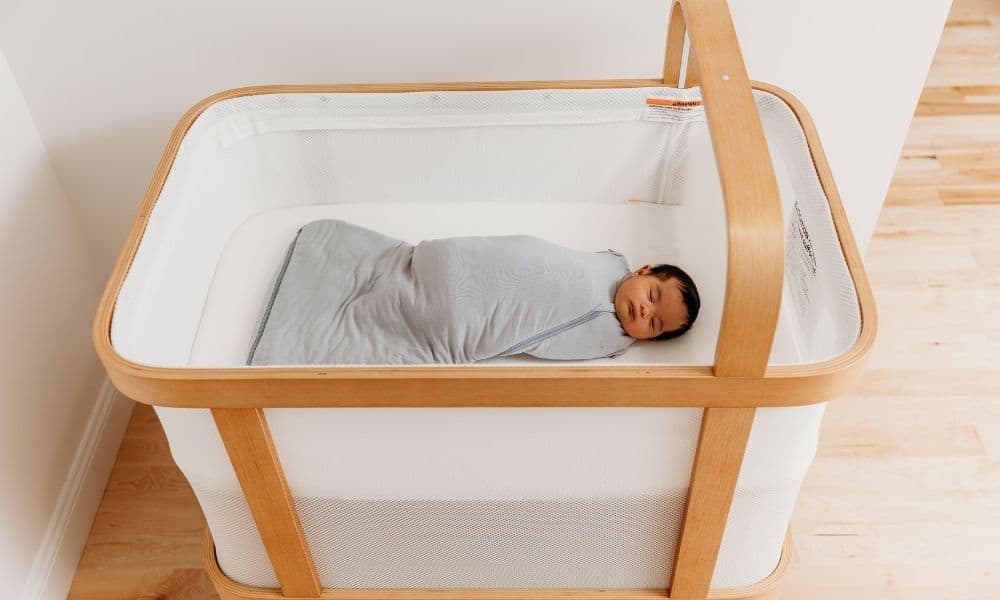
Understanding Baby’s Temperature
In all cases, what’s really most important is the same underlying question we use for most of life’s problems: How can we find a comfortable middle ground that meets the needs of everyone involved?
In the case of managing a newborn’s temperature, the best starting point is understanding whether they’re actually too hot or cold. How can you tell? A few simple things can help you get a better sense of baby’s overall temperature:
- First, keep in mind that babies have immature circulation. It can be tempting to feel a cold baby foot and start adding layers, but a more accurate place to check is on the chest or the back of the neck.
- Flushed skin, sweating, or damp hair are signs that baby is likely too warm overall
- On the other side, blotchy [or mottled] skin or shivering can signal that baby is cold
- While sneezing may seem like a sign of a cold baby, in the early days it’s usually a baby clearing out amniotic fluid and other irritants.
As a starting point, the general recommendation being to dress baby in one light layer more than you would wear to feel comfortable.
One important note that we often see come up in homes is confusion around hats for sleep because babies are frequently wearing them in the hospital. At home, however, AAP guidelines recommend no hats indoors for sleep, both because they can contribute to overheating and because they can come off and become a loose item in the sleep space. This is just one example of how a Newborn Care Specialist can help parents understand the nuances of newborn care recommendations, and, more importantly, the “why” behind them.
Safe Sleep Doesn’t Have to Look Exactly the Same in Every Home
Successful newborn care requires understanding why a recommendation exists so you can adapt it thoughtfully in different scenarios. When we know more, we have more options to choose from for problem solving. If we know how to read baby’s comfort cues, take into consideration the general guidelines, and adjust accordingly, lots of different baseline house temperatures can be perfectly safe and comfortable.
In a cooler home that might look like a baby sleeping in warmer pajamas and/or using a higher TOG sleep sack or swaddle. In a warmer home, that might mean baby sleeps in a diaper and light swaddle with increased air circulation in the room. Rather than chasing a “perfect number,” a Newborn Care Specialist can help parents look at the whole environment and adjust the pieces we want to control. In a case where a family wants their home colder or warmer than AAP guidelines recommends while working with one of our team members, that might also include having a signed liability waiver on file alongside making appropriate adjustments for baby.
Ultimately, comfort and safety are more than just a number on a thermostat. They’re shaped by culture, generation, season, and personal preference. Understanding the difference between something that feels unfamiliar to us and something that is actually unsafe gives families and professionals more room to collaborate and create environments, routines, and habits that respect the needs of everyone in the home.

Helpful tips from your team at Well Supported Family.
Expert postpartum and newborn advice you can trust.
Since 2016, Well Supported Family has walked alongside thousands of new parents as they adjust to life with a newborn. Our certified Postpartum Doulas and Newborn Care Specialists offer daytime, overnight, and 24/7 in-home care across the United States, bringing steady, knowledgeable support right to your door. If you’re recovering from birth, navigating feeding, or simply overwhelmed by the lack of sleep, we’re here to make those early days feel a little lighter.
Want to explore in-home care for your new family? Reach out today.